
Lymphedema (LE) is a swelling that occurs in one of your arms or legs. Although rare, it also can occur in both arms or both legs at the same time. It is a complicated process involving the lymphatic system.
The lymphatic system circulates lymph fluid throughout the body to collect bacteria, viruses, and waste products. The collected waste products are filtered out by the lymphocytes or infection-fighting cells in the lymph nodes and then flushed from the body.
When the lymphatic system does not effectively drain lymph fluid from the body (or limb), lymphedema occurs. One of the most common signs of lymphedema is chronic edema or the abnormal accumulation of fluid in the body.
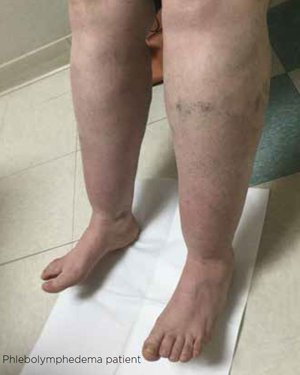 "An estimated five to 10 million Americans suffer from chronic edema caused by LE," according to an article in VEIN Magazine, an industry publication for vein specialists. "Cancer and its treatment are usually designated as the leading cause, however chronic venous insufficiency may be the most important predictor in the development of lower extremity LE, says Darren Wennen, the article's author.
Signs and symptoms of lymphedema
The symptoms of lymphedema include the following:
- Swelling of part of or an entire arm or leg, including fingers or toes
- Feeling of heaviness or tightness in the extremities
- Restricted range of motion in the limb
- Discomfort in arm or leg
- Recurring infections in the affected limb
- Thickening of the skin on arm or leg
The swelling of an affected limb can range from mild, in which there are barely noticeable changes, to extreme changes in which the limb is not functional.
Types of lymphedema
Lymphedema can be a primary or secondary medical condition. Secondary lymphedema is more common than primary lymphedema.
Primary lymphedema is genetic and is more common in women than men. The main types of primary lymphedema include:
- Milroy's disease or congenital lymphedema, which starts during infancy and causes the lymph nodes to develop abnormally.
- Meige's disease or lymphedema praecox, which has a later onset during childhood or puberty. Lymph vessels develop without the usual valves to keep the lymph fluid from back flowing into the limbs.
- Late-onset lymphedema or lymphedema tarda, which presents after age 35.
In secondary or acquired lymphedema, another disease or condition damage the lymph nodes and cause the lymphedema; this includes:
- Surgery for a variety of cancers including breast (as was the case for the actress Kathy Bates), melanoma, gynecological, head and neck, prostate, testicular, bladder or colon, during which lymph nodes are often removed
- Radiation treatment, which affects surrounding lymph nodes
- Cancer, such as a tumor growing close to and blocking a lymph node or vessels
- Infection, which restricts the lymph system from properly draining; this is most commonly caused by parasites in tropical or subtropical areas of the world
Who is at risk of lymphedema?
Anytime the lymphatic system is compromised, whether through surgery, injury, or medical treatment, there is a risk of developing lymphedema. The heredity factor also adds to the risk, given a family history of the condition.
Causes of lymphedema
Any condition, procedure, or treatment that damages the lymph system, whether nodes or vessels can cause lymphedema.
The most common cause of lymphedema is the removal or damage to lymph nodes from specific cancer treatment.
Diagnosing lymphedema
When diagnosing lymphedema, the cause is often apparent. After a physical assessment and medical history, your doctor will order diagnostic tests to evaluate the lymphatic system. They can include:
- Magnetic resonance imaging (MRI), which scans the affected limb(s) using a powerful magnet and radiofrequency waves to create 3D images.
- Computerized tomography (CT) takes a cross-section x-ray of the area of concern to check where there might be a lymphatic system blockage.
- Doppler ultrasound uses high-frequency sound waves to check for lymphatic system blockages.
- Radionuclide imaging or lymphoscintigraphy uses an injection of radioactive dye followed by a scan of the limb(s) to check for a lymph system blockage.
One important factor in diagnosing lymphedema is to rule out a more common diagnosis of venous insufficiency.
Listen to a few leading vein specialists speaking about the diagnosis and treatment of lymphedema.
Treatment options for lymphedema
There is no cure for lymphedema, but there are methods and treatments to reduce the swelling and prevent further complications. It can be managed to relieve symptoms and complications of the condition. Scrupulous care of the involved limb is essential to avoid complications of the condition.
The treatment choices all target the same goal: to reduce swelling by pushing the fluid out of the limb. Treatments include:
- Exercise: light exercise to encourage lymph fluid to move out of the extremity
- Compression wrap: ace wraps to the entire limb will help to push the fluid back into the body trunk
- Compression sleeve: this sleeve not only encourages backflow of the fluid out of the limb but can help to keep the swelling down, if it has been successfully moved by other treatments
- Pneumatic compression: an intermittent pump hooked to a special sleeve on the affected limb gently moves the fluid
- Massage or manual lymph drainage: this works to move the fluid out of the limb. If you have a skin infection, active cancer, blood clots, congestive heart failure or if you have had radiation therapy, you are exempt from this treatment
- Surgery: in extreme cases, surgery can remove excess fluid to relieve pressure
All treatment plans for lymphedema should be followed under the guidance of a qualified vein and lymphatic specialist.
Complications of lymphedema
Complications of lymphedema can be serious. They include:
- Infection, usually due to cellulitis (bacteria within the actual thickness of the skin) or lymphangitis (bacteria affecting the lymph vessels)
- Lymphangiosarcoma is a rare, soft tissue cancer
Prevention and/or recovery
Being aware of the personal risk factors of developing secondary lymphedema, especially while undergoing radiation therapy or surgery for cancer, will allow you to exercise some of the following preventive measures:
- Protect an affected limb from injury, especially any cuts, scrapes or puncture wounds, including blood draws.
- Avoid excessive use of the limb during a recovery phase.
- Avoid any form of heat to the limb, especially a heating pad or hot compress.
- Elevate the arm or leg above heart level whenever possible.
- Do not wear constrictive clothing.
- Have blood pressure checked on the opposite side, if an arm is involved.
- Keep the affected arm or leg well-groomed, including skin and nail care.